Journey Through Slavonia's Fortresses, Castles & Wine Trails - 6 days
Croatia, Zagreb and surrounding, Zagreb
Duration
Transportation
Route
Follow the historic fortresses, elegant castles, and renowned wine trails of Slavonia on an unforgettable journey through one of Croatia's richest regions in heritage, culture, and gastronomy.
Discover the rich cultural heritage, magnificent castles and fortresses, renowned wine regions, and authentic gastronomy of Slavonia, one of Croatia's most captivating regions. This six-day journey takes you through historic towns, breathtaking natural landscapes, and centuries-old traditions, offering a perfect blend of history, culture, nature, and unforgettable local experiences.
Select your stay
Select the departure date from the calendar
-
How many travelers?
Itinerary
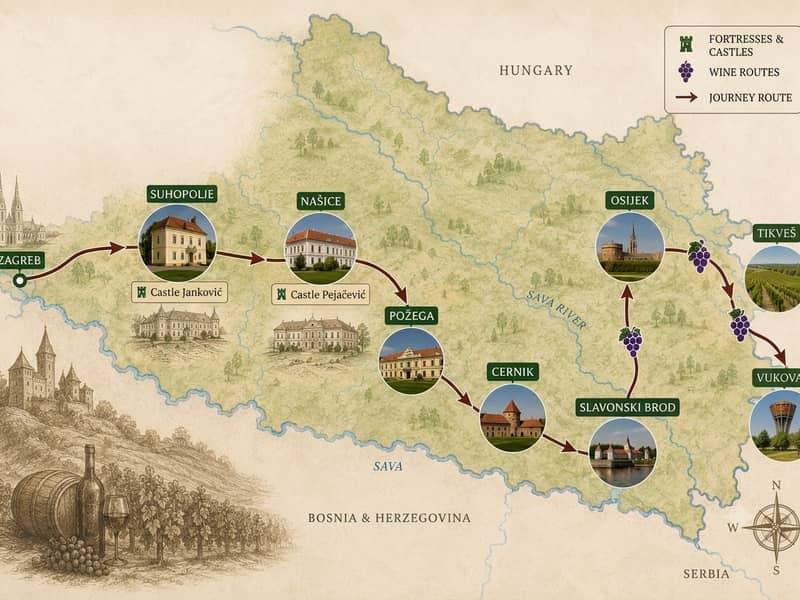
Zagreb
Arrival in Zagreb and transfer to the hotel for check-in. Enjoy a walking tour of the historic city centre, including Ban Jelačić Square, Zagreb Cathedral, and the Upper Town, with its iconic Stone Gate and St. Mark's Church. Free time to relax with a coffee along the lively Tkalčićeva Street or visit the unique Museum of Broken Relationships. Dinner at a traditional restaurant featuring authentic Croatian cuisine. Overnight in Zagreb.
Zagreb – Suhopolje - Našice
After breakfast, depart for Suhopolje to visit the magnificent Janković Castle, one of the finest examples of Late Baroque and Historicist architecture in Slavonia.
Originally built in the 18th century, the castle acquired its present appearance through later renovations carried out under the ownership of the distinguished Janković noble family, whose influence played a significant role in the development of the region. Surrounded by an extensive landscaped park and elegant walking paths, the castle has been beautifully restored and today serves as a Tourist Information Centre, a luxury boutique hotel, and a venue for cultural events, exhibitions, and festivals. Its impressive facade, refined interiors, and fascinating history make it a perfect destination for visitors wishing to experience the rich cultural heritage and tranquil beauty of Slavonia.
Lunch will be served at Restaurant Park, proudly awarded the "Taste of Croatian Tradition" quality label, celebrating authentic regional cuisine.
In the afternoon, continue to Našice to visit the recently restored Pejačević Castle, one of the most important aristocratic residences in Slavonia. Built in the 18th century, the castle was for centuries the home of the influential Pejačević family, whose legacy significantly shaped the cultural, economic, and political life of the region.
The estate consists of the Old Castle and the New Castle, connected by a covered passage and surrounded by a beautiful English-style park. Today, the castle houses the Našice Heritage Museum, featuring valuable collections dedicated to the history of the town, the Pejačević family, and the rich cultural heritage of Slavonia.
Enjoy some free time for a relaxing walk through the castle park before check-in at the hotel. Overnight stay.
Našice – Požega – Cernik – Slavonski Brod
After breakfast, depart for Požega, a charming historic town nestled in the picturesque Požega Valley, surrounded by the gentle slopes of Papuk, Psunj, and Krndija mountains. Known as the "Heart of the Golden Valley," Požega delights visitors with its rich cultural heritage, beautiful natural surroundings, and warm hospitality. Enjoy a guided walking tour of the historic town centre, often referred to as the "Slavonian Athens." Highlights include Holy Trinity Square and the magnificent Cathedral of St. Teresa of Ávila. Afterwards, enjoy some free time to relax with a coffee in one of the town's inviting cafés.
Lunch will be served at a traditional restaurant or wine cellar in Požega or the surrounding area, where you will have the opportunity to savour authentic Slavonian specialities such as Slavonian kulen, čobanac (traditional meat stew), and homemade desserts.
In the afternoon, continue to Cernik to visit the impressive Cernik Fortress, dating back to the 13th century and a Renaissance-Baroque stronghold that played an important role in the defence against the Ottoman Empire. The tour also includes a visit to the Franciscan Monastery and the Church of St. Peter and St. Paul, one of the oldest monasteries in continental Croatia and renowned for its valuable historic library. Continue to Slavonski Brod for hotel check-in. Dinner and overnight stay.
Slavonski Brod
After breakfast, enjoy a guided tour of Slavonski Brod, a vibrant town situated on the banks of the Sava River, on the border with Bosnia and Herzegovina. Rich in history and cultural heritage, Slavonski Brod successfully combines its historic charm with a modern way of life.
Visit the impressive Brod Fortress, one of the largest and best-preserved Baroque fortresses in Croatia. Built between 1715 and 1780 as an important Habsburg military stronghold…The fortress has been transformed into the city's cultural centre and today hosts numerous exhibitions, concerts, and cultural events throughout the year.
Continue to the Tamburitza House, the world's first museum dedicated to the tamburitza, Croatia's traditional string instrument. Through an engaging collection of exhibits, discover the history and development of this iconic instrument, an essential part of Slavonian music, folklore, and celebrations.
Take a pleasant walk along the Sava River promenade to the Franciscan Monastery and the Church of the Holy Trinity, one of Slavonski Brod's most significant historical landmarks. Dating back to the 18th century, the monastery is renowned for its beautifully decorated Baroque interior, valuable library, and remarkable collection of religious artworks. Today, it remains not only an important spiritual centre but also a guardian of Slavonia's rich cultural and historical heritage.
Enjoy a traditional Slavonian lunch at a local restaurant in Slavonski Brod or the surrounding area.
After lunch, take a stroll along the town's lively pedestrian promenade before visiting the Brlić House with a professional guide. Located on the main town square, this elegant 19th-century Neoclassical residence, built in 1885, was the family home of Ivana Brlić-Mažuranić, Croatia's most celebrated children's author, often referred to as the "Croatian Andersen." It was here that she wrote some of her most famous works, including Croatian Tales of Long Ago. Today, the Brlić House is a protected cultural monument and an important venue for literary and cultural events celebrating her legacy and Croatian literature. Return to the hotel. Dinner and overnight stay.
Slavonski Brod - Osijek - Tikveš
After breakfast, depart for Osijek, the largest city in eastern Croatia. Accompanied by a local guide, enjoy a sightseeing tour of the city's historic Baroque Fortress (Tvrđa), one of the best-preserved Baroque fortified urban complexes in Croatia. Highlights include the Holy Trinity Monument, erected in the 18th century as a votive monument following the plague epidemic, the elegant main square, the Jesuit Church, the Franciscan Church, the historic Water Gate—the only surviving original city gate—and the impressive remains of the old fortification walls.
Following a traditional Slavonian lunch at a local restaurant, continue to Kopački Rit Nature Park. Situated between the Drava and Danube rivers, Kopački Rit is one of Europe's best-preserved floodplain and wetland areas, renowned for its extraordinary biodiversity.
Enjoy a memorable visit to this unique ecosystem, including a boat cruise, opportunities for birdwatching, and a walk along the park's well-maintained educational trails, offering a close encounter with one of Croatia's most remarkable natural treasures. The journey continues to Tikveš Castle. The Complex is a 19th-century hunting and country estate built by members of the Teschen branch of the Habsburg family once a residence of the Habsburg family and later used as one of President Tito's hunting lodges. Today, the Tikveš Visitor and Interpretation Centre presents the fascinating history of the castle and the exceptional natural heritage of Kopački Rit through interactive multimedia exhibitions. In the evening, enjoy dinner at a traditional restaurant near Kopački Rit or Bilje, featuring regional specialities, including fresh freshwater fish dishes and authentic Slavonian cuisine. Return to Osijek. Overnight stay.
Osijek - Vukovar - Zagreb
After breakfast, depart for Vukovar, a city of profound historical significance and resilience, situated on the banks of the Danube River. Visit the Memorial Cemetery of the Victims of the Homeland War, followed by a tour of the magnificent Eltz Manor, an elegant Baroque palace that today houses the Vukovar Municipal Museum and the renowned Bauer Collection, one of the museum's outstanding collections of Croatian modern art.
Enjoy a guided walk through the town centre and lunch at a local restaurant before visiting the iconic Vukovar Water Tower, the city's most powerful symbol of courage, endurance, and renewal. Beautifully restored, the tower offers visitors an immersive insight into the tower's wartime history and its significance as a memorial.
In the afternoon, continue to Ilok, Croatia's easternmost town, renowned for its centuries-old winemaking tradition. Visit the famous Iločki Podrumi Winery, where, in the elegant surroundings of the historic Principovac estate, you will enjoy a guided wine tasting featuring some of the region's finest wines. There will also be an opportunity to purchase local wines and gourmet products. After the visit to Ilok, depart for Zagreb, arriving in the evening and bringing your journey through the fortresses, castles, and wine trails of Slavonia to a memorable conclusion.
Terms of travel
Price includes
1 overnight in Zagreb (hotel 4*, twin/double room, breakfast)
1 overnight in Našice (hotel 4*, twin /double room, breakfast)
2 overnights in Slavonski Brod (4* hotel, twin/double room, breakfast and dinner)
1 overnight in Osijek (4* hotel, twin/double room, breakfast)
5 lunches as outlined in the itinerary
1 dinner in a local restaurant
Guided city tours: Zagreb, Požega, Cernik, Slavonski Brod, Osijek, Vukovar, Kopački rit
Admission tickets: House of Tambura, Pejačević Castle, Janković Castle, Eltz Castle, Kopački Rit Park
Wine tasting at an Ilok winery
Tour leader
Bus transfer
Travel guarantee insurance and liability insurance, tour organization costs, and VAT
Price excludes
Beverages with meals
Optional services and expenses not included in the itinerary
Personal expenses, gratuities, and souvenirs
Single room supplement
Note
The activity schedule is tentative and subject to adjustment based on weather conditions, the group's interests and pace, and logistical considerations. The order of visits may be changed depending on schedules and the availability of attractions.
Please bring: comfortable footwear and clothing suitable for the outdoors, sun and rain protection, personal identification documents, and your health insurance card.
Ideal period: spring to early autumn (April–October).
Zagreb
Zagreb-An Old City with a Young Soul
Zagreb is the Croatian capital and largest city in Croatia by population. Historically, the city of Zagreb has grown from two neighboring settlements, Gradec and Kaptol, which form the core of today's Zagreb, its historical center. According to the legend, Zagreb got its name when an old ancient ban, tired and thirsty, made the girl Manda bring water from the spring. Ban said: "Mando, dear, zagrabi!“ (zagrabi – grabs)
Zagreb is the administrative, economic, cultural, and scientific center of Croatia. By its position, Zagreb belongs to the cities of Central Europe. Zagreb is situated in continental central Croatia, on the southern slopes of Medvednica and on the banks of the Sava River. Its favorable geographic position in the southwestern corner of the Pannonian Basin, between Alpine, Dinaric, Adriatic, and Pannonian regions, the cause is the fact that Zagreb is the transport hub between Central and Southeastern Europe and the Adriatic Sea. Due to its history and significance, Zagreb is rich in monuments and architecture. The center of Zagreb are considered a historic district Upper Town and Kaptol, and Donji Grad, which has an exceptional diversity of architecture from Baroque to the present day. The center is surrounded on the north side with residential neighborhoods with higher levels of housing, and to the south of the former working-class neighborhoods that are experiencing strong reurbanisation. Appearance and arrangement, Zagreb is a typical Central European city.
Zagreb is the largest cultural center of Croatia. The town has several institutions that traditionally have great prestige. In music, it is the Lisinski Concert Hall, in the world of theater, ballet, and opera Croatian National Theatre, and among libraries National and University Library. Among many quality museums and galleries, the cultural echo exhibitions maybe the most prominent Klović Palace. Zagreb also hosts several significant festivals, such as Animafest - World Festival of Animated Film, which takes place every even year, INmusic - one of the largest open-air festivals in Croatia, International Folklore Festival, theater festival Eurokaz, and Festival of contemporary dance. Zagreb has a film festival, „Zagreb Film Festival“, and is particularly interesting, ZagrebDox, a documentary film festival.
From important exhibitions of recent visual expression, there is Zagreb Salon. From music festivals, there is Zagrebfest, one of the oldest events of Croatian pop music, an avant-garde music festival, then Music Biennale Zagreb every odd year, and the Festival of the Zagreb Philharmonic Orchestra. Since 1996, the streets of downtown Zagreb maintains Cest is dBest, an international multimedia festival of street performers. In the summer, there are also open-air concerts, mostly in the Upper Town (Summer in the Upper Town).
Zagreb’s cultural calendar is packed with excitement year‑round. In winter, the city transforms into a wonderland during Advent, with festive markets, cozy cafés, and twinkling lights creating a magical holiday atmosphere. In spring and summer, the Festival of Lights illuminates iconic landmarks with stunning installations, while open‑air concerts and performances fill parks and plazas with music and joy.In recent years, Zagreb has become known for its growing array of unique museums that delight curious travelers of all ages. Beyond classic galleries and history institutions, you’ll find innovative attractions such as the internationally acclaimed Museum of Broken Relationships, the playful Museum of Laughter, the imaginative Museum of Travel, the inspiring Museum of Sports Triumphs, and even a Museum of Magic — each offering surprising, interactive, and unforgettable experiences.
Whether you’re enjoying lively festivals, discovering quirky museums, or simply soaking in the city’s warm hospitality, Zagreb offers a rich blend of culture, fun, and discovery that keeps visitors coming back.
SLAVONSKI BROD
Slavonski Brod, one of the oldest cities in Croatia and the administrative center of Brod-Posavina County, is located on the banks of the Sava River. The city is known for its rich history, preserved cultural heritage, and traditional Slavonian hospitality. The combination of historical landmarks, green spaces, and top-notch gastronomy makes it an attractive destination for anyone who wants to get to know authentic Slavonia.
Brod Fortress: The most famous symbol of the city is one of the largest Baroque fortresses in Croatia. Built in the 18th century as part of the defense system of the Habsburg Monarchy, today it is the site of numerous cultural events, exhibitions, and manifestations.
Korzo: The main city promenade is a favorite gathering place for residents and visitors. Surrounded by shops, cafes, and restaurants, Korzo provides an opportunity for a relaxed walk and enjoyment of the city's everyday life.
Ivana Brlić-Mažuranić House: The Brlić family's family home where Ivana Brlić - Mažuranić wrote some of her most beautiful and famous fairy tales.
Franciscan Monastery: One of the most valuable sacral monuments in the city is located in the very center of Slavonski Brod. The Franciscan Monastery and the Church of the Holy Trinity from the 18th century stand out for their Baroque architecture, richly decorated interior and valuable library that preserves numerous old manuscripts and books.
Poloj Beach: Located along the Sava River, Poloj is a favorite city picnic spot and one of the most famous river beaches in Croatia. During the summer months, it attracts many visitors who enjoy swimming, sports activities, walks and relaxation in nature.
Spavarska Street: a unique street in Croatia, consisting of about eighty rafts lined up side by side on the Sava River, from the city center to the Poloj beach.
Sava Promenade: The landscaped banks of the Sava River are ideal for walking, cycling and relaxing in nature. The view of the river and the peaceful surroundings provide a special experience throughout the year.
Events: The city organizes numerous cultural, musical and traditional events throughout the year. Of particular note are the folklore performances and events that celebrate Slavonian customs, music and gastronomy.
Gastronomic offer: Slavonski Brod is the right destination for lovers of traditional cuisine. Try the famous Slavonian kulen, čobanac, fish paprikash, homemade sausages and other specialties, along with top-quality wines and brandies from this region.
Excursions to the surrounding area: Nature lovers can also visit Dilj gora, which offers numerous hiking and cycling trails.
Slavonski Brod is a destination that combines rich history, cultural heritage and recognizable Slavonian hospitality. Regardless of whether you are attracted by historical sights, natural beauty or traditional gastronomy, this city will provide you with an authentic experience of Slavonia and a pleasant stay.
POŽEGA
Požega, located in the heart of the Golden Valley, is one of the most beautiful Slavonian cities, captivating with its rich history, cultural heritage and relaxed continental charm. Surrounded by the green slopes of Papuk, Psunj and Krndija, it offers the ideal combination of urban life and natural beauty.
The city is proud of its elegant Baroque Holy Trinity Square, which represents the historical center of Požega and is one of the most beautiful squares in continental Croatia. The city is especially valuable due to the magnificent Cathedral of Saint Teresa of Avila, the centuries-old tradition of viticulture and numerous cultural events that enrich the life of the city throughout the year.
Požega is the perfect starting point for exploring the Papuk Nature Park, tasting top-quality Slavonian wines and enjoying authentic gastronomy. The combination of rich heritage, hospitality and natural surroundings makes it an excellent destination for a relaxing holiday and discovering the beauties of continental Croatia.
NAŠICE
Našice, located on the slopes of Krndija and near the Papuk Nature Park, is one of the most beautiful Slavonian towns that combines a rich history, cultural heritage and green natural surroundings. The town is known for its aristocratic past, spacious parks and a relaxed atmosphere that attracts fans of continental tourism.
A special place is occupied by the magnificent Pejačević Castle, surrounded by one of the most beautiful parks in Croatia, which today houses the Našice Regional Museum. In the very center of the town stands out the Baroque-Gothic Church of St. Anthony of Padua, while the nearby church of St. Martin, built by the Knights Templar in the 13th century, testifies to the rich history of this region.
Našice is an excellent destination for lovers of nature, active holidays and Slavonian gastronomy. The proximity of the Papuk Nature Park, numerous cycling and hiking trails and the hospitality of the hosts make this town an ideal choice for a relaxing holiday and exploring the beauties of eastern Croatia.
VUKOVAR
Vukovar, located at the confluence of the Vuka River and the Danube, is one of the most famous cities in eastern Croatia, recognizable for its rich history, cultural heritage and symbolism of Croatian contemporary history. The city on the Danube delights with a combination of renovated Baroque buildings, river views and a hospitable Slavonian atmosphere.
Of particular note are the magnificent Eltz Castle, which houses the Vukovar City Museum, the Baroque city core and the promenade along the Danube that offers a beautiful view of one of Europe's largest rivers. Vukovar is also known for the Vukovar Water Tower, a symbol of Croatian unity and suffering, as well as the Homeland War Memorial Center, which preserves the memory of an important part of Croatian history.
With a rich cultural offer, Vukovar is an excellent destination for river cruises, cycling and exploring the wine roads of eastern Slavonia. The combination of history, culture, natural beauty and superb Slavonian gastronomy makes Vukovar an indispensable destination for anyone who wants to get to know the authentic east of Croatia.