Istria Uncovered: A 6-Day Journey Through History & Heritage
Croatia, Istria, Rovinj
Duration
Transportation
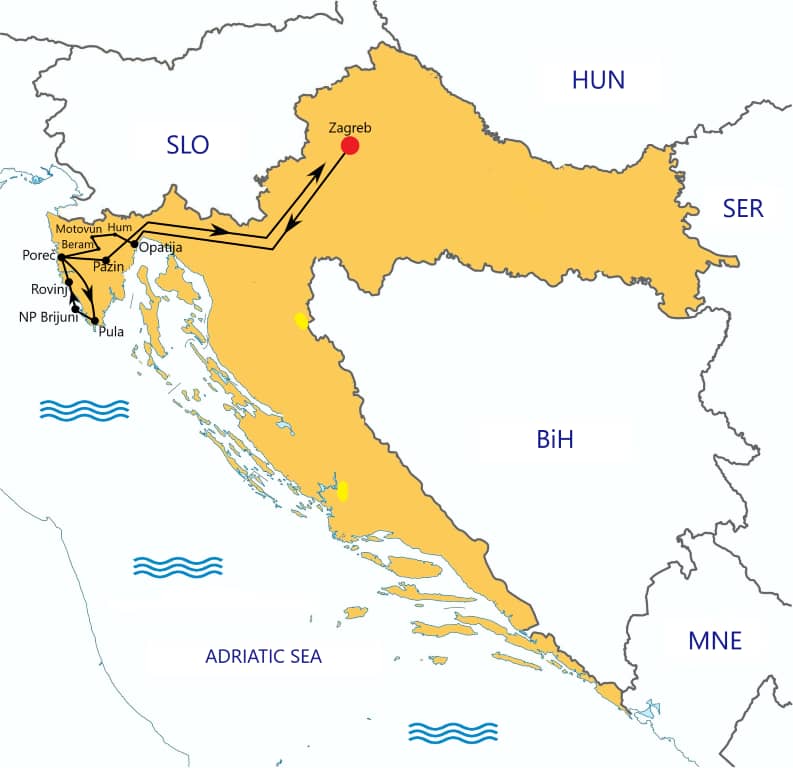
Route
Explore Istria and Zagreb in 6 days – from medieval towns and Roman ruins to truffle tastings and thrilling zipline views.
Discover the magic of Istria and Zagreb in six unforgettable days. Wander medieval towns like Hum and Motovun, admire UNESCO-listed frescoes in Beram, and taste the region’s famous truffles in traditional pasta. Explore Pula’s Roman ruins, the lush Brijuni Islands, and Rovinj’s charming cobbled streets. Thrill-seekers can zipline over Pazin Canyon for breathtaking views. End your journey in Zagreb, enjoying the city like a local – strolling, sipping coffee, or exploring its quirky museums. A journey of history, culture, and unforgettable experiences awaits.
Itinerary
ZAGREB
Upon arrival at Zagreb Airport, you will be transferred to your hotel to settle in and relax. Depending on your arrival time, take a stroll through the city center and soak up the vibrant atmosphere of Croatia’s capital. Enjoy the evening at your own pace, perhaps discovering a local café or simply admiring the charming streets and historic squares. Overnight.
ZAGREB-OPATIJA
Start your morning with a guided tour of Zagreb, exploring the fortified medieval Upper Town, the colorful St. Mark’s Church, the impressive Cathedral of St. Stephen, the historic Stone Gate, and the elegant Croatian National Theatre. Wander through the University area and absorb the charm of the city’s streets.
In the afternoon, depart for Opatija, the famed coastal resort that once welcomed Habsburg royalty and European cultural figures such as Gustav Mahler, Isadora Duncan, and A.P. Chekhov. Upon arrival, enjoy a leisurely walk along the picturesque seaside promenade and admire the historic villas and lush gardens. Overnight in Opatija.
OPATIJA- HUM- MOTOVUN- BERAM - POREČ
Begin your day with a visit to Hum, known as the smallest town in the world. Stroll along its medieval walls, explore the charming town loggia on the central square, and pass through the historic Town Gate.
Next, continue to Motovun, a picturesque hilltop fortress town surrounded by dense chestnut forests. Enjoy panoramic views of the Istrian countryside and immerse yourself in its medieval charm.
Stop for lunch at a local restaurant in this region, which is renowned for its truffles. We highly recommend trying a dish featuring truffles, such as Istrian fuži pasta with truffles, to experience the authentic flavors of Istria.
In the afternoon, visit Beram, home to the Church of St. Mary on Skriljine, where you can admire the famous Gothic frescoes, including the remarkable Dance Macabre by the local painter Vincent, listed by UNESCO as a World Cultural Monument.
Conclude the day with your transfer to Poreč, where you can enjoy dinner at your hotel or at a local restaurant, savoring the coastal cuisine. Overnight in Poreč.
POREČ - PULA - BRIJUNI ISLANDS NATIONAL PARK - ROVINJ - POREČ
Start the day with a departure to Pula, one of Istria’s most historic cities. Enjoy a guided tour of the city, including the remarkably preserved Roman Arena, the Triumphal Arch, the Temple of Augustus, and the Gate of Hercules. Immerse yourself in the rich Roman heritage and imagine life in ancient times.
Next, continue to the Brijuni Islands National Park, a stunning archipelago of 14 islands and islets. Explore Veliki Brijun Island, wandering through lush subtropical vegetation, spotting wildlife, and discovering archaeological treasures. Take in the serene landscapes and enjoy the unique atmosphere of this protected natural and cultural site.
In the afternoon, visit Rovinj, often called the jewel of the Istrian coast. Walk through its narrow cobbled streets, discover art galleries and charming cafes, and climb up to the Church of St. Euphemia for breathtaking views over the Adriatic.
Return to Poreč for overnight. You may choose to enjoy dinner at your hotel or at a local restaurant, sampling fresh seafood and regional specialties while reflecting on the day’s discoveries.
POREČ- SV. PETAR U ŠUMI - PAZIN - ZAGREB
Depart from Poreč to visit the Pauline Monastery of St. Peter in the Woods (Sv. Petar u Šumi), founded in the 12th century. Explore this historic cultural center of Istria and admire its serene architecture and artistic treasures.
Continue to Pazin, located in the heart of Istria. Explore the medieval fortress perched above the dramatic Pazin Cave, and visit the Church of St. Nicholas, which is home to remarkable 15th-century frescoes. For those seeking adventure, we highly recommend the zipline over Pazin Canyon: soar across the deep gorge, enjoy spectacular panoramic views of the castle and surrounding landscape, and feel the thrill of flying above one of Istria’s most scenic natural wonders.
In the evening, return to Zagreb, with time to relax and enjoy a final dinner in the city at your leisure. Overnight in Zagreb.
ZAGREB
After breakfast, enjoy some free time in Zagreb before your transfer to the airport. You may choose to stroll through the charming city center, sip coffee in one of the many cozy cafés just like the locals do, or explore some of Zagreb’s quirky and unique museums, such as:
Museum of Broken Relationships – an emotional and fascinating collection of personal stories and mementos, Museum of Illusions – interactive exhibits and optical illusions perfect for fun photos; Zagreb 80s Museum – a nostalgic journey through life in 1980s Croatia; Archaeological Museum – rich collections spanning prehistoric times to Roman artifacts ....
Take with you the memories of enchanting Istria and the vibrant atmosphere of Zagreb before your transfer to Zagreb Airport for departure.
Terms of travel
Price includes
- private transfers with english speaking driver
- accommodation in hotels 4* or 5* in double rooms, single rooms
- breakfast
- private city tours with English speaking guide
- stay tax
Price excludes
- meals
- tickets to museums, castles
- everything that is not included under the price includes
Zagreb
Zagreb-An Old City with a Young Soul
Zagreb is the Croatian capital and largest city in Croatia by population. Historically, the city of Zagreb has grown from two neighboring settlements, Gradec and Kaptol, which form the core of today's Zagreb, its historical center. According to the legend, Zagreb got its name when an old ancient ban, tired and thirsty, made the girl Manda bring water from the spring. Ban said: "Mando, dear, zagrabi!“ (zagrabi – grabs)
Zagreb is the administrative, economic, cultural, and scientific center of Croatia. By its position, Zagreb belongs to the cities of Central Europe. Zagreb is situated in continental central Croatia, on the southern slopes of Medvednica and on the banks of the Sava River. Its favorable geographic position in the southwestern corner of the Pannonian Basin, between Alpine, Dinaric, Adriatic, and Pannonian regions, the cause is the fact that Zagreb is the transport hub between Central and Southeastern Europe and the Adriatic Sea. Due to its history and significance, Zagreb is rich in monuments and architecture. The center of Zagreb are considered a historic district Upper Town and Kaptol, and Donji Grad, which has an exceptional diversity of architecture from Baroque to the present day. The center is surrounded on the north side with residential neighborhoods with higher levels of housing, and to the south of the former working-class neighborhoods that are experiencing strong reurbanisation. Appearance and arrangement, Zagreb is a typical Central European city.
Zagreb is the largest cultural center of Croatia. The town has several institutions that traditionally have great prestige. In music, it is the Lisinski Concert Hall, in the world of theater, ballet, and opera Croatian National Theatre, and among libraries National and University Library. Among many quality museums and galleries, the cultural echo exhibitions maybe the most prominent Klović Palace. Zagreb also hosts several significant festivals, such as Animafest - World Festival of Animated Film, which takes place every even year, INmusic - one of the largest open-air festivals in Croatia, International Folklore Festival, theater festival Eurokaz, and Festival of contemporary dance. Zagreb has a film festival, „Zagreb Film Festival“, and is particularly interesting, ZagrebDox, a documentary film festival.
From important exhibitions of recent visual expression, there is Zagreb Salon. From music festivals, there is Zagrebfest, one of the oldest events of Croatian pop music, an avant-garde music festival, then Music Biennale Zagreb every odd year, and the Festival of the Zagreb Philharmonic Orchestra. Since 1996, the streets of downtown Zagreb maintains Cest is dBest, an international multimedia festival of street performers. In the summer, there are also open-air concerts, mostly in the Upper Town (Summer in the Upper Town).
Zagreb’s cultural calendar is packed with excitement year‑round. In winter, the city transforms into a wonderland during Advent, with festive markets, cozy cafés, and twinkling lights creating a magical holiday atmosphere. In spring and summer, the Festival of Lights illuminates iconic landmarks with stunning installations, while open‑air concerts and performances fill parks and plazas with music and joy.In recent years, Zagreb has become known for its growing array of unique museums that delight curious travelers of all ages. Beyond classic galleries and history institutions, you’ll find innovative attractions such as the internationally acclaimed Museum of Broken Relationships, the playful Museum of Laughter, the imaginative Museum of Travel, the inspiring Museum of Sports Triumphs, and even a Museum of Magic — each offering surprising, interactive, and unforgettable experiences.
Whether you’re enjoying lively festivals, discovering quirky museums, or simply soaking in the city’s warm hospitality, Zagreb offers a rich blend of culture, fun, and discovery that keeps visitors coming back.
Opatija
Located in the beautiful Kvarner Bay between the Adriatic Sea and Mount Učka, Opatija has been one of Europe’s most desirable seaside destinations since the early days of tourism. Its mild climate, elegant architecture, and stunning sea views—especially along the famous Lungomare promenade—make it a perfect place for relaxation and scenic exploration.
Among its most iconic landmarks is the “Girl with the Seagull”, a symbol of Opatija and a favorite photo spot. The 12 km long Lungomare promenade offers picturesque coastal walks past historic villas, beaches, and lush Mediterranean greenery.
Opatija is also known for its beautifully landscaped parks, such as Angiolina Park and St. Jacob’s Park, featuring exotic plants, elegant pathways, and cultural landmarks. For nature lovers, Učka Nature Park offers hiking trails, breathtaking viewpoints, and unspoiled landscapes.
The town combines rich history with culture, seen in places like the Croatian Museum of Tourism, as well as a long-standing tradition of hospitality, highlighted by the historic Hotel Kvarner—one of the first hotels on the Adriatic.
Visitors can enjoy excellent cuisine in local restaurants, featuring fresh seafood and regional specialties such as Kvarner shrimp and traditional desserts.
With its blend of history, nature, wellness, and refined coastal charm, Opatija remains a timeless destination that continues to captivate visitors from around the world.
Pula
The most famous and important monument, the starting and ending point of every tour of the city Pula - the Arena - the building where the gladiator fights. It was built in the first century AD during the reign of Emperor Vespasian, at the same time with the greatest and most famous building of its kind - Coliseum in Rome. Arena is located outside the old city walls because of its size and geographical benefits, and to the city itself leads us to the road justified during Emperor Vespasian, after whom it was named - Via Flavia, which today is one of the city's major thoroughfares.
The other two significant and well-preserved ancient Roman structures are the triumphal arch, the Arch of the Sergi from the 1st century and the Temple of Rome and Augustus, also from the 1st century, which was built in the forum during the reign of the Roman Emperor Augustus. As a result of its rich political history, Pula is a city with a cultural mix of people and languages from the Mediterranean and Central Europe, ancient and contemporary. Pula's architecture reflects these layers of history. Residents are commonly fluent in foreign languages, especially Italian, and often German and English. In Pula there are two museums at this moment - the Archaeological Museum and Historical Museum of Istria. Other museum exhibitions can be found in the amphitheater, Temple of Augustus and Nesactium.
The natural beauty of Pula's surrounding areas and the turquoise blue Adriatic Sea made the city an internationally popular summer vacation destination. Nearby jewel are the national park Brijuni, which were visited by many world leaders when it was a summer residence of the elderly statesman Josip Broz. Roman villas and temples still lie buried among farm fields and along the coast of several surrounding fishing and farming villages. Coastal waters offer beaches, fishing, diving to the wreck of ancient Roman galleys and warships from the First World War, cruise to the pristine coves and islands, large and small. Pula's most famous beaches are Gortan Cove on Lungomare, Ambrela and Havajsko at Verudela, Sandy Bay and Valkane.
ROVINJ
Located on the western coast of the Istrian Peninsula in Croatia, Rovinj is one of the most charming and visited towns on the Adriatic Sea. With a population of around 14,000 residents and covering an area of approximately 72 square kilometers, Rovinj combines small town charm with rich cultural heritage.
The old town is situated on a peninsula, dominated by the Baroque Church of St. Euphemia, the city’s patron saint. From the church’s bell tower, visitors can enjoy panoramic views of the blue sea, nearby islands, and rolling hills.
Rovinj is also known for its numerous galleries, art studios, and vibrant art scene that reflects a long-standing tradition of visual arts. Every summer, the town hosts Rovinj Photodays, an international photography festival attracting artists and photography enthusiasts.
Beyond cultural landmarks, the surroundings of Rovinj offer stunning natural attractions such as the Brijuni National Park, famous for its untouched nature and diverse wildlife, and the Golden Cape, a peninsula with walking and cycling trails perfect for active relaxation.
Rovinj is famous for its exceptional cuisine. Fresh seafood, local olive products, truffles, and Istrian wines provide a great quality taste experience.